
The way children learn best has always been hiding in plain sight — through play.
Introduction
Every parent wants their child to learn, grow, and keep up. However, what most don’t want is the pressure, the drills, the flashcards held up before a child is ready. The dilemma between wanting progress and protecting childhood is one that every urban parent navigates daily.
Play-based learning resolves that dilemma. It is a combination of fun and growth—it is the most research-aligned and developmentally appropriate way for young children to build real knowledge, real skills, and real confidence. And when it happens inside a purposefully designed space, it works faster and with more lasting results than any structured classroom approach can deliver at this age.
This is what parents across India are beginning to understand. And it is what Funblock, a STEM-certified indoor play area for children aged 2–7, was built to deliver.
What play-based learning actually means
Play-based learning is planned and purposeful play. Every activity is designed with a clear goal: to build skills and to build skills and support every child’s development. It is a deliberate approach to early childhood education where the environment, the activities, and the challenges are designed to teach, but through doing, exploring, and discovering, rather than being told.
When a child climbs an obstacle course, they are not just playing. They are building gross motor skills, learning to assess risk, developing persistence, and solving a physical problem in real time. When a child stacks blocks, they are not just passing time. They are laying the early foundations of engineering thinking, spatial reasoning, and focused effort.
Educational games for kids that are built around this principle create an invisible curriculum — one in which children participate willingly, enthusiastically, and without the resistance that formal instruction often produces.
Why pressure slows children down
The developing brain between ages 2 and 7 is not built for passive instruction. It is built for active exploration. When a child is placed under performance pressure — asked to sit still, repeat, memorise, and be assessed — the experience often produces anxiety rather than learning.
Anxiety narrows attention. It shrinks the willingness to try new things, which is precisely what early learning requires. Children who feel pressured to perform often disengage from the activity entirely, or develop an early aversion to the subject being taught.
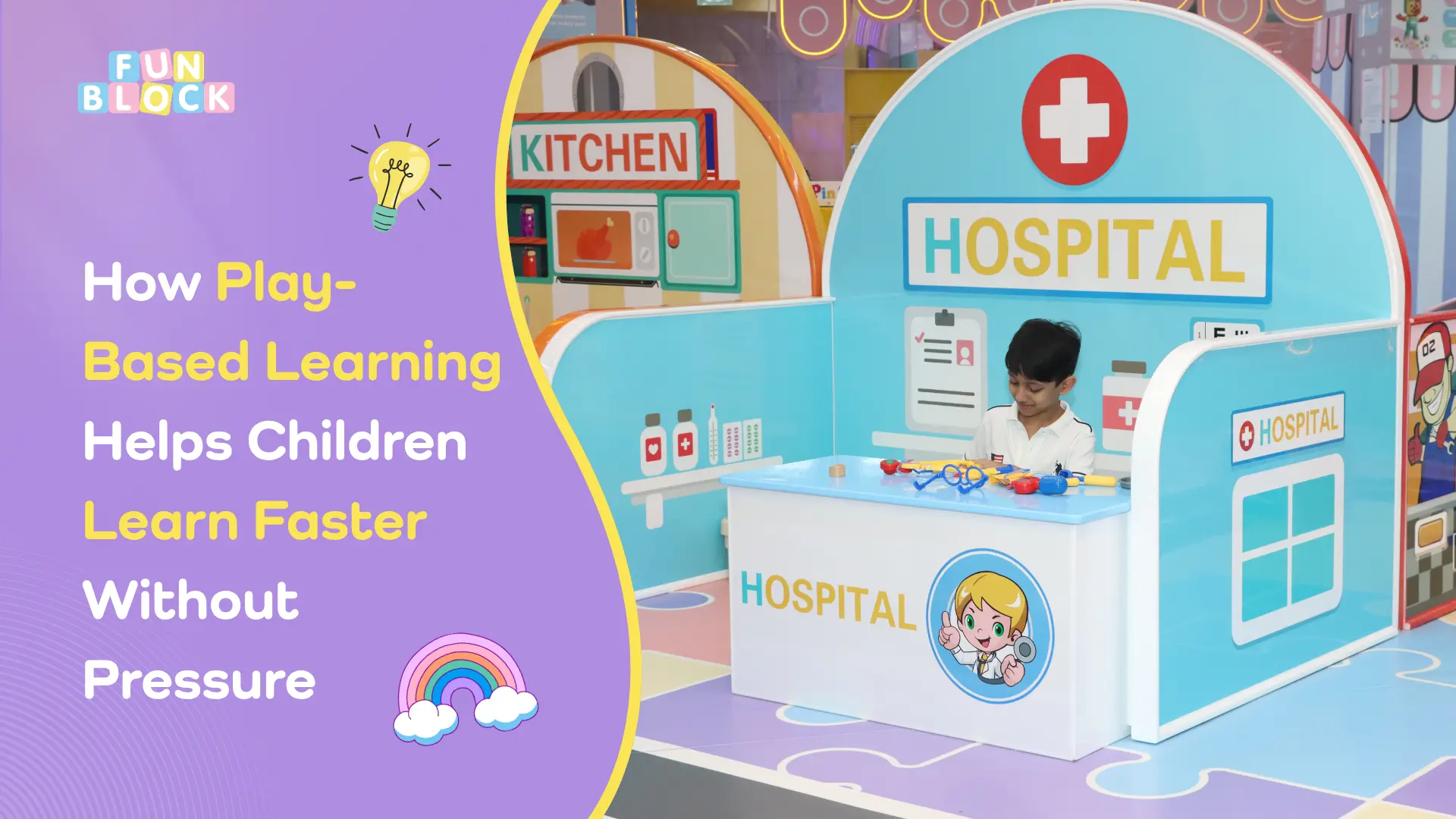
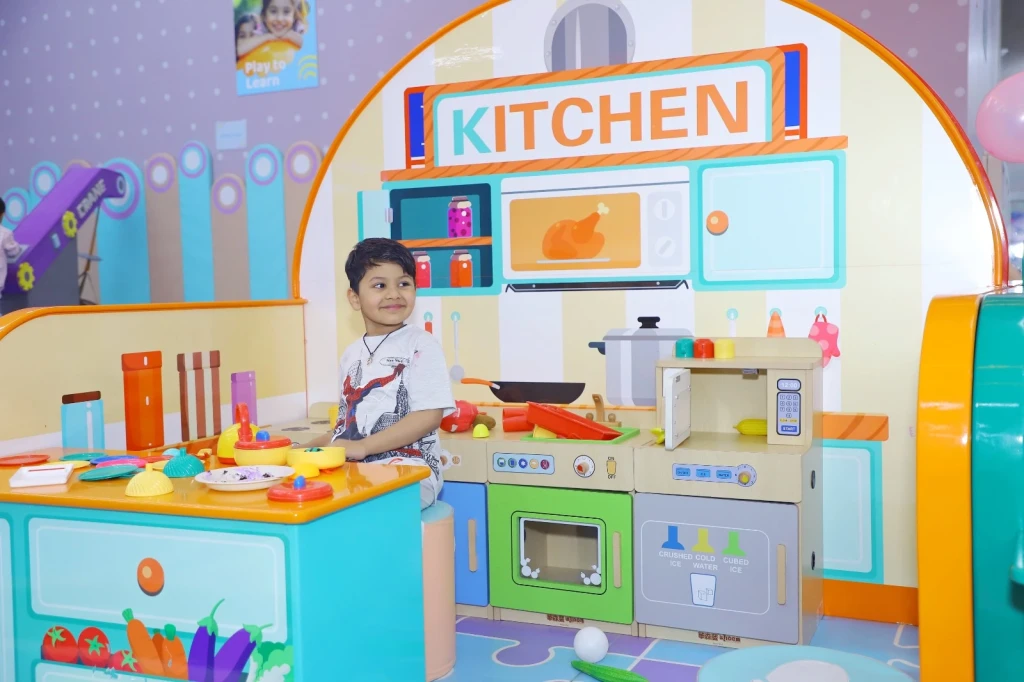
Play removes that pressure completely. A child exploring the Role Play Zone is not worried about getting it right. A child working through the Block Station is not thinking about being evaluated. They are simply engaged, and in that state of genuine, motivated engagement, the brain absorbs, connects, and retains at its highest capacity.
Learning games for kids that create this environment are not a luxury. For children aged 2–7, they are the most effective learning environment available.
How Funblock is built around play-based learning
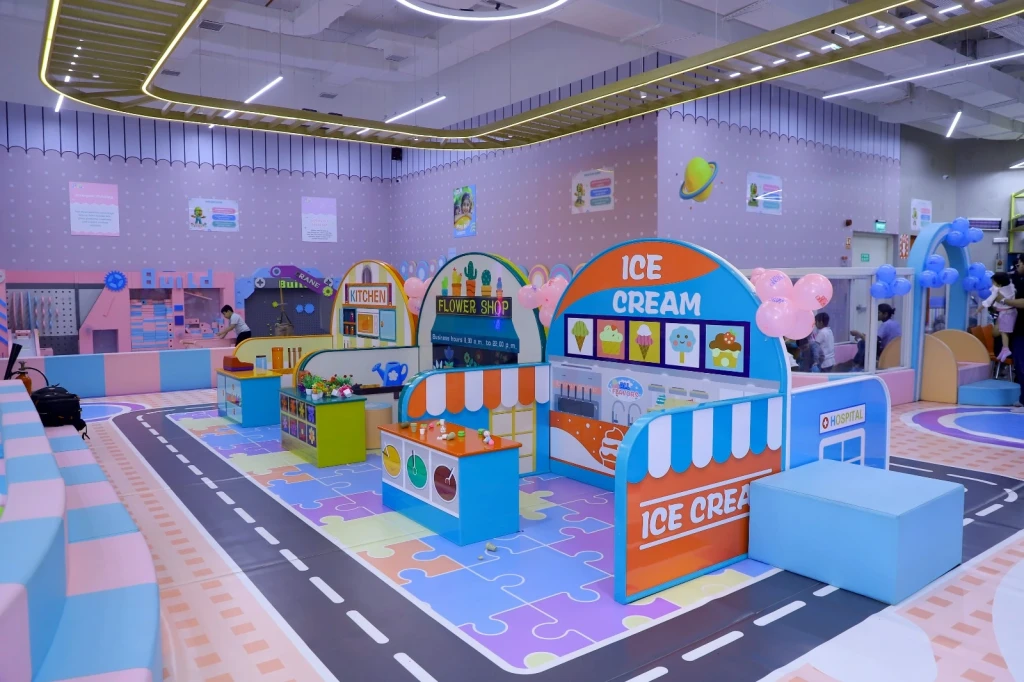
Every zone within Funblock is designed around a specific developmental function, grounded in the understanding of how young children actually grow. The space does not ask children to learn. It creates conditions where learning is natural.
Active Play Zones
- Ball Pool Area — Builds balance, body coordination, and spatial awareness. Children solve physical problems in real time, learning to navigate space, gauge distance, and manage their own bodies with confidence.
- Obstacle Course — Develops gross motor skills, agility, focus, and problem-solving. Every challenge on the course is a small lesson in persistence — try, adapt, succeed.
- Trampoline Zone — Strengthens core coordination and rhythm while stimulating brain function. The physical regulation that comes from jumping directly supports focus and cognitive readiness.
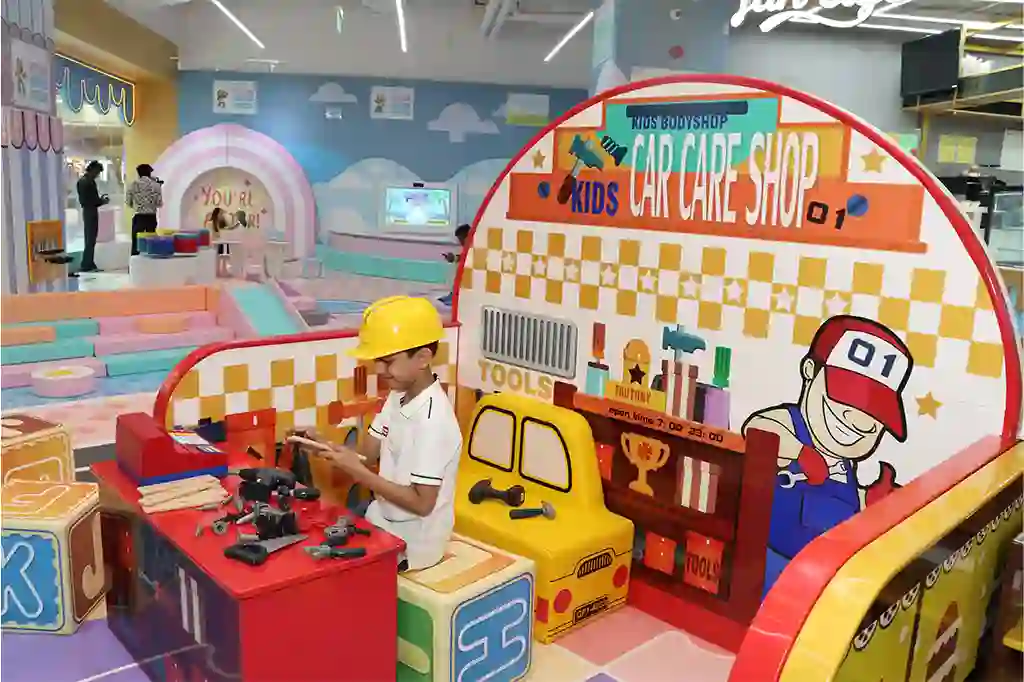
- Builder Zone — Strengthens grip, arms, and balance while building coordination and confidence through physical effort. Children learn what their bodies are capable of.
Creative and Cognitive Zones
- Role Play Zone — Sparks imagination, empathy, and real-world reasoning. Children rehearse language, social interaction, and emotional thinking through structured imaginative play — skills that serve them in every area of life.
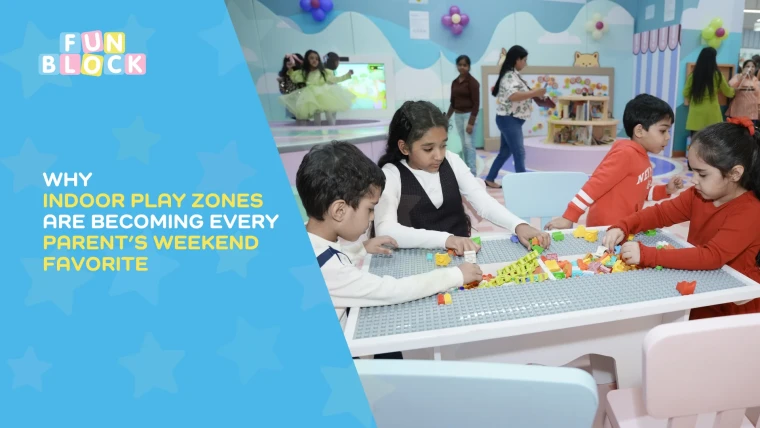
- Block Station — Builds early engineering awareness, spatial thinking, patience, and problem-solving. This is educational learning in its most direct form, disguised entirely as play.
- Music and Movement Zone — Encourages self-expression through rhythm, movement, and sound. Builds coordination and focus while laying foundations for language development.
- Reading Corner — A calm, language-rich space where children build focus, expand vocabulary, and develop the habit of sustained independent attention. A necessary counterweight to high-energy zones.
Sensory and Social Zones
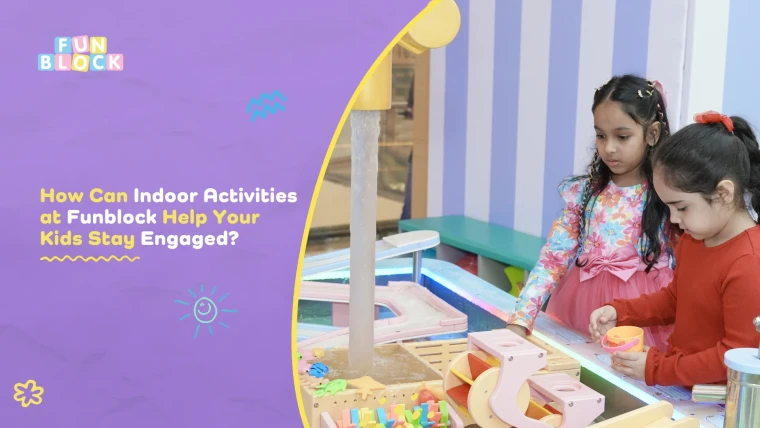
- Organic Seed Pit — Provides natural sensory exploration using organic materials. Children dig, discover, and engage with textures that screens and classroom environments simply cannot replicate. Sensory engagement at this stage directly feeds curiosity, motor development, and cognitive processing.
Each zone supports a different dimension of development. Together, they create a complete educational learning environment that functions without a single moment of formal instruction.
What children aged 2–7 actually build through play
The developmental gains from quality play-based learning are measurable, specific, and foundational.
| Developmental area | What play builds | Funblock zone |
|---|---|---|
| Gross motor skills | Coordination, balance, agility | Obstacle Course, Trampoline, Ball Pool |
| Fine motor skills | Grip, hand-eye coordination, precision | Block Station, Builder Zone |
| Cognitive development | Problem-solving, spatial thinking, focus | Block Station, Obstacle Course |
| Language and communication | Vocabulary, expression, storytelling | Role Play Zone, Reading Corner |
| Social-emotional learning | Empathy, cooperation, self-regulation | Role Play Zone, Music Zone |
| Sensory processing | Tactile awareness, curiosity, motor refinement | Organic Seed Pit, Ball Pool |
| Early STEM foundations | Engineering logic, cause and effect | Block Station, Builder Zone |
None of these outcomes require a child to sit at a desk. All of them happen naturally when the environment is designed correctly.
A space where parents can be present without hovering
One often-overlooked dimension of play-based learning is the parent’s role. Children learn better when they feel secure — and security does not require constant parental intervention. It requires knowing that a parent is nearby and that the environment is safe.
Funblock is designed with this balance in mind. Every zone is visible, every surface is cushioned and clean, and trained staff are present throughout the space. Parents can step back, relax at the FunCafe — which offers comfortable seating, fresh food, Wi-Fi, and a workspace — without losing sight of their child or their peace of mind.
The result is a visit where children are genuinely free to explore, and parents are genuinely able to rest. Both leave with something they came for.
To understand how Funblock’s indoor activities support engagement in more detail, explore our guide on indoor activities at Funblock.
Play-based learning vs traditional early instruction
| Traditional early instruction | Play-based learning at Funblock | |
|---|---|---|
| Learning mechanism | Passive reception | Active exploration and doing |
| Child’s internal state | Compliance, performance anxiety | Curiosity, motivation, engagement |
| Retention | Short-term, surface-level | Deeper, connected to experience |
| Social development | Limited peer interaction | Constant cooperative and parallel play |
| Parental experience | Homework support required | Child develops independently |
| Developmental breadth | Narrow (academic focus) | Physical, cognitive, sensory, social |
Funblock: where learning happens without the child knowing
The most powerful early education is the kind children simply experience as joy. They know it as the best hour of their week — as climbing and building and creating and pretending — and they carry the developmental gains of that hour long after they have forgotten what they did.
This is what Funblock delivers. Not a lesson plan. Not a curriculum with pressure attached. A space where children aged 2 to 7 grow completely, naturally, and at exactly the pace that is right for them.
With locations in Dwarka, NSP, Gaur City, and Y Junction Hyderabad, Funblock is accessible to families across Delhi, Noida, and Hyderabad. Walk in any day of the week, or book your child’s birthday party online today.
Conclusion
Play-based learning is not a softened alternative to real education. For children between 2 and 7, it is real education — grounded in developmental science, aligned with how the brain actually builds knowledge at this stage, and far more effective than any pressure-driven approach.
Funblock was designed to make that kind of learning available to every family, within a space that is safe, purposeful, and genuinely excellent. The zones are not attractions. They are instruments, each one calibrated to develop a specific capability in the children who use them.
If you are looking for a space where your child can learn faster, grow more confidently, and have the time of their life doing it, Funblock is that space.
FAQ
- What is play-based learning and why is it effective for young children?
Play-based learning is an approach to early childhood development where children build skills, knowledge, and confidence through structured play rather than formal instruction. It is effective because it aligns with the natural curiosity and active learning style of children aged 2–7, producing deeper understanding and stronger retention without performance pressure. - How do educational games for kids support development at Funblock?
Every zone at Funblock functions as an educational game for kids — from the Block Station’s engineering challenges to the Role Play Zone’s social and language development. Children build real skills across physical, cognitive, sensory, and emotional domains through play they are genuinely motivated to engage in. - At what age should children start play-based learning?
Play-based learning is appropriate from the earliest stages of childhood. Funblock is designed for children aged 2–7, a period considered one of the most developmentally significant windows in a child’s life. Starting early gives children the strongest possible foundation across all developmental areas. - Is play-based learning as effective as structured academic instruction for toddlers?
For children aged 2–7, play-based learning consistently produces better outcomes than traditional instruction. The developing brain at this stage learns best through movement, sensory engagement, and active exploration — not passive reception. Structured academic instruction becomes more appropriate as children enter formal schooling. - How does Funblock make sure children are actually learning and not just playing?
Funblock’s zones are not generic play equipment. Each one is designed around a specific developmental purpose — gross motor, fine motor, cognitive, sensory, social, or language development. The structure of the space ensures that meaningful development is happening continuously, even when children are simply following their curiosity. - What makes learning games for kids at Funblock different from screen-based educational apps?
Screen-based educational apps offer passive, visual engagement with limited physical or social benefit. Funblock’s learning games for kids involve full-body participation, peer interaction, tactile exploration, and real-world problem-solving — producing a depth of developmental engagement that no screen-based experience can replicate. - Can a single visit to Funblock genuinely support my child’s development?
Yes. Each visit to Funblock covers multiple developmental domains — physical, cognitive, sensory, and social — within a single session. Regular visits compound these benefits significantly, supporting continuous progress across all areas of early childhood development. - Is Funblock suitable for children who are shy or slow to warm up?
Funblock’s environment is designed to let children engage at their own pace. There is no requirement to participate in group activities, and quieter zones like the Reading Corner and Organic Seed Pit offer lower-stimulation options. Children who need more time to settle find the space welcoming rather than overwhelming.