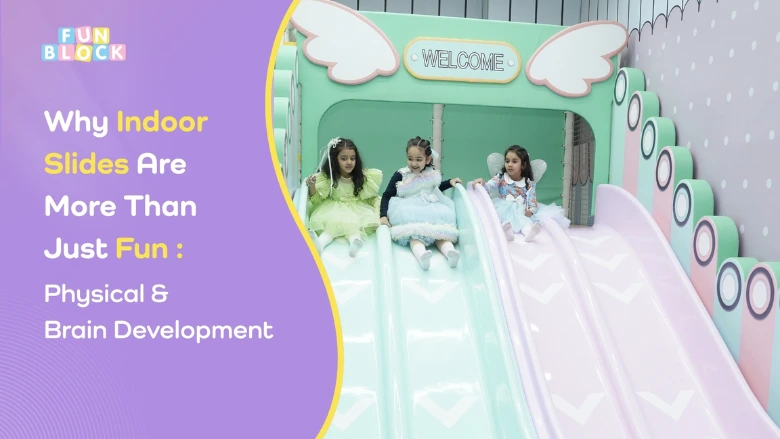

Watch a child standing at the top of a slide. Before they take off, there’s always that little pause. They measure the distance, determine where to put their hands, assess the height, and then proceed. Every run down a children’s indoor slide uses both the body and the brain, and it all happens in a matter of seconds.
To a child, it is simply the most exciting part of the visit. What they do not realize is that every climb and slide helps them build important skills. In an indoor play zone, these moments happen naturally through movement and exploration.
Why Slides Are More Than Just Fun
Although sliding may seem straightforward, it actually involves several coordinated movements. As children climb up and slide down, they use different muscle groups to stay balanced, stable, and in control of their movements. Children who regularly use indoor playground slides benefit from:
- Gross Motor Capabilities
- Stability and equilibrium
- Being conscious of one’s body
- Control of posture
- Coordination of movement
Children can develop these vital physical foundations through every climb and slide, which will help them with everyday movement, playground activities, and future sports.
What the Brain Is Doing on the Way Down
An indoor play slide encourages children to make quick decisions in real time.
Questions such as:
- How fast will I go?
- Where should I place my hands?
- When should I slow down?
are processed almost instantly during each run. Indoor play activities built around this kind of physical challenge develop spatial reasoning, depth awareness, and the ability to respond quickly to situations. Children who engage with this regularly build stronger decision-making habits, and those habits grow precisely because they keep going back for one more run.
Why the Climb Matters as Much as the Slide
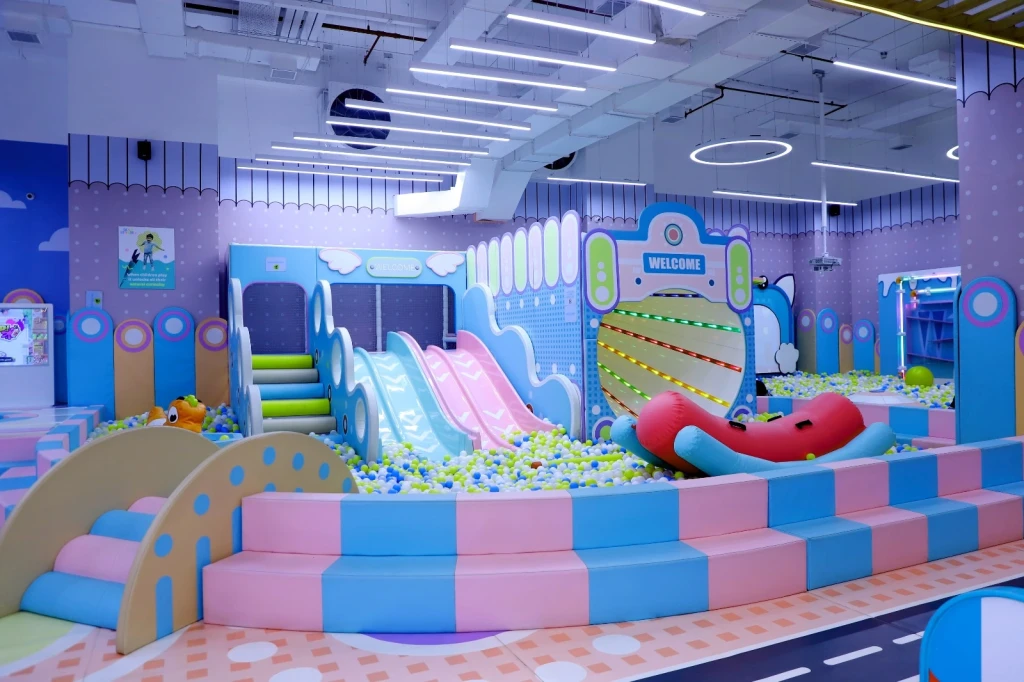
The climb is where most of the progress occurs, but the slide is what kids remember. A child must plan their movement, coordinate their limbs, and commit to a physical sequence with each step up a ladder or ramp. Climbing and sliding together create an engaging play experience where children use different muscles, practise balance, and improve coordination through every movement.
Children benefit from the climb by:
- Strengthening their upper body
- Enhancing coordination
- Being more aware of space
- Gaining confidence by moving independently
Children are inspired to climb again, try new routes, and keep pushing themselves by the satisfying finish provided by the slide.

What the Right Indoor Space Makes Possible
Children can stay active, explore, and engage in their favorite activities uninterrupted in an indoor play area. Unlike outdoor play areas, indoor play zones can be enjoyed in any weather.
Kids can:
- Take breaks at the Funcafe
- Play with their parents at the slide
- Interact with other children
- Land right into the ball pool which adds an extra layer of fun
- Play more but be safe as there is soft landing pads everywhere
Research published by the American Academy of Pediatrics continues to emphasize the importance of active play in supporting healthy physical, social, and cognitive development.
The more children engage in meaningful indoor play activities, the more these skills strengthen over time.
Conclusion
Every ride on a children’s indoor slide is more than just an exciting moment. It is an opportunity for children to climb, balance, make decisions, and build important physical skills through play. Active play helps kids develop their confidence, physical balance, coordination, body awareness, and spatial reasoning. Children gain important developmental benefits when climbing, sliding, and exploration are combined in a well-designed play environment.
Children can engage in intentional play experiences that promote both physical and cognitive development at Funblock’s STEM-certified indoor play areas located across cities.
Plan a visit today and give your child the opportunity to learn, grow, and stay active through play.
FAQ
- What are the physical benefits of an indoor slide for children between the ages of two and seven?
Indoor slides help children develop body awareness, balance, coordination, and gross motor skills. Additionally, sliding and climbing improve overall physical wellness by strengthening the muscles in the legs and core. - How does a STEM-certified indoor play environment differ from a regular indoor play zone?
A STEM-certified space is designed with a clear developmental purpose in mind, reflected in the equipment and layout. The play structures, layouts, and activities are designed to encourage movement, exploration, problem-solving, and age-appropriate learning. - What makes an indoor playground slide better than an outdoor one for development?
Kids can consistently play on indoor playground slides regardless of the weather. Their cognitive and physical skills can be enhanced by more repetitive climbing and sliding exercises. - How do indoor play activities like sliding help to develop the brain?
While sliding, kids naturally measure distance and speed and make quick decisions. These exercises foster the growth of decision-making, problem-solving, and spatial awareness. - What should I look for in an indoor jungle gym with a slide for my child?
Look for slides at different heights, a proper climbing structure, and a setting where children can take multiple runs safely. The best setups are designed for repeated use, not just a single go. A STEM-certified indoor play environment built for ages 2 to 7 gives children the most complete experience for this stage of their development.