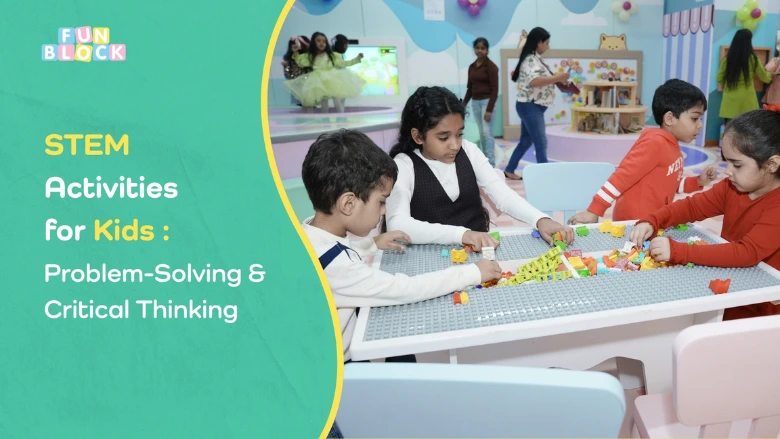

Watch a 3-year-old try to fit a block into a gap that is slightly too small. They will try it one way, turn it, then swap it for a different block. They worked it out on their own, and they will remember how. That is STEM learning. And between the ages of 2 and 7, it happens all the time when children are in the right environment.
Between the ages of 2 and 7, children learn best through hands-on experiences. STEM activities for preschoolers give them opportunities to explore, experiment, and discover solutions on their own. Children start to develop the critical-thinking and problem-solving abilities they will need throughout their lives through intentional play. At Funblock, children engage in age-appropriate STEM experiences that encourage curiosity, creativity, and independent thinking through play.
Why STEM Learning Matters for ages 2 and 7
Children between the ages of 2 and 7 are naturally curious and eager to understand how the world around them works. Early experiences are crucial in shaping the brain’s architecture, laying the groundwork for later learning, behavior, and problem-solving skills, according to research from Harvard University’s Center on the Developing Child.
For parents looking for educational activities for kids, STEM activities provide opportunities for children to think, observe, experiment, and solve simple challenges through hands-on play. Every time a child experiences that cycle, their reasoning strengthens. The habits formed in these early years affect their problem-solving in school and other situations. For parents seeking STEM activities for kindergarteners or younger toddlers, these habits begin to develop well before kindergarten.
How STEM Education at This Age Differs from Schooling
When looking for STEM activities for kindergarten, most parents expect a structured lesson. However, STEM learning at this age happens best through play and exploration. A child watches water change shape as it moves from one container to another, learning that liquids take the shape of their container while exploring simple concepts such as volume and flow. When building with blocks, a child quickly learns that if a structure falls, changing the design can make it stronger. These hands-on experiences help children develop observation, reasoning, and problem-solving skills through play.
STEM learning activities for this age group are entirely play-based, with the child leading the way. The National Association for the Education of Young Children (NAEYC) notes that play-based learning helps young children develop problem-solving, reasoning, and decision-making skills.
How STEM Activities Build Problem-Solving Skills
Between the ages of 2 and 7, problem-solving often begins through physical exploration. Children learn by moving, building, testing, and trying different approaches until they find one that works. STEM learning activities present children with a challenge and provide multiple ways to solve it, encouraging them to think, adapt, and make decisions on their own.
Over time, these experiences develop persistence, flexible thinking, and the confidence to approach new challenges with different solutions.
Developing Critical Thinking Through Science and Play
Critical thinking at this age starts with a pause. A child who stops to look at what happened before trying again is already thinking critically. Science activities for preschoolers are built around this moment.
A child is performing a simple experiment when they work with sand, water, or building materials, changing one thing to see what happens. They formulate a concept, test it, and modify their ideas in light of their observations. This is the basis for scientific reasoning, and play fosters its development. Science activities for preschoolers are most effective when outcomes are open-ended, and the child leads. How strongly these habits develop depends on the quality of the activity.
Why the Right Play Space Changes What Is Possible
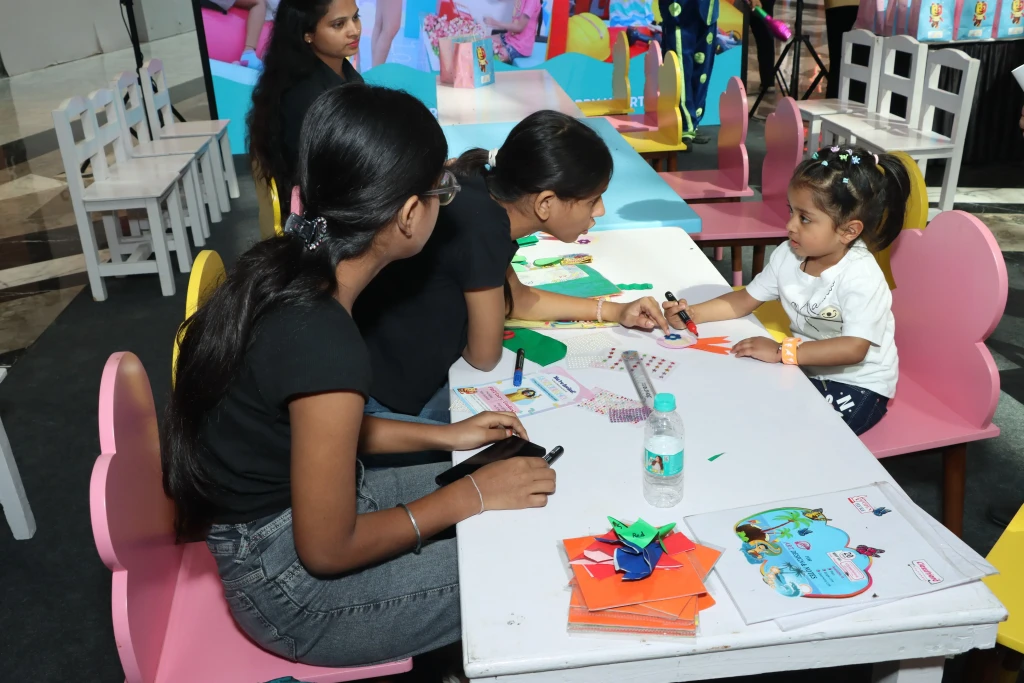
STEM learning needs more than a good activity. It needs a well-defined, intentional play-learn space which is guided by staff
A well-designed indoor play zone built for ages 2 to 7 gives children exactly this. They can move from building to water play to obstacle challenges, each one asking a different kind of thinking from them.
Families searching for STEM activities near me are often looking for places where every corner has something different to try. Funblock’s STEM-certified indoor play spaces bring together a variety of age-appropriate zones that encourage curiosity, creativity, and independent thinking through purposeful play.
Conclusion
The thinking skills children develop between ages 2 and 7 are built through play, real problems, and having the space to work things out at their own pace. STEM activities during these years lay down reasoning habits that carry through everything that comes after.
A well-designed, STEM-certified indoor game zone provides regular opportunities for children to build these skills through meaningful play experiences. Funblock, with locations in Dwarka, NSP, Gaur City, and Y Junction in Hyderabad, provides a space specifically designed for this age group.
Plan a visit today and give your child opportunities to learn, explore, and grow through play.
FAQ
- What are good STEM activities for kindergarten children to try before school starts?
The ages just before and during kindergarten are a good time for building challenges, water flow experiments, and obstacle-based play. These activities ask children to think through more than one step at a time, which is exactly the kind of thinking school will ask of them. At Funblock, the building blocks, obstacle course, and seed pit are all designed for this age and this purpose. - What are the most effective STEM activities for preschoolers?
Building blocks, sand experiments, and obstacle challenges are among the most effective STEM activities for preschoolers. Each one gives children a real situation to work through and leaves them to figure out the next step. That process of trying, seeing what happens, and trying differently is how problem-solving habits form at this age. - How do STEM learning activities help children develop critical thinking?
STEM learning activities give children materials and a challenge, then step back. Children have to observe, decide what to try, check the result, and go from there. When this happens across different activities over time, children build the habit of thinking through a situation before and after they act. That habit is what critical thinking looks like at this age. - Where can I find STEM activities near me for children aged 2 to 7?
Look for a STEM-certified indoor play venue built for this age group. A good venue has multiple activity zones, trained staff, and a space where children can move freely between different kinds of challenges. Funblock, with locations in Dwarka, NSP, Gaur City, and Y Junction Hyderabad, is built specifically for children aged 2 to 7. - What makes an indoor play zone a good place for STEM learning?
A good indoor play zone gives children a wider range of challenges than a single setting can. Multiple zones, different materials, and space to move between them means children regularly have something new to work through. That variety builds flexible thinking and problem-solving habits over time. - What science activities for preschoolers build critical thinking?
Water play, seed and soil exploration, going through challenges, and sensory experiments all work well. Each puts children in a situation where they have to observe what is happening and decide what to do next. Doing this across different types of play builds the reasoning habits that feed into critical thinking at school age. - How often should children participate in STEM activities?
Children benefit from regular exposure to STEM experiences through everyday play. Even short periods of exploration several times a week can help strengthen curiosity, confidence, and critical-thinking skills over time. - At what age should children start STEM activities?
Children as young as 2 can benefit from STEM learning activities when these are play-based and age-appropriate. The goal at this age is to build experience by trying something, observing what happens, and trying differently. Those experiences form reasoning habits that grow alongside the child through kindergarten and beyond.